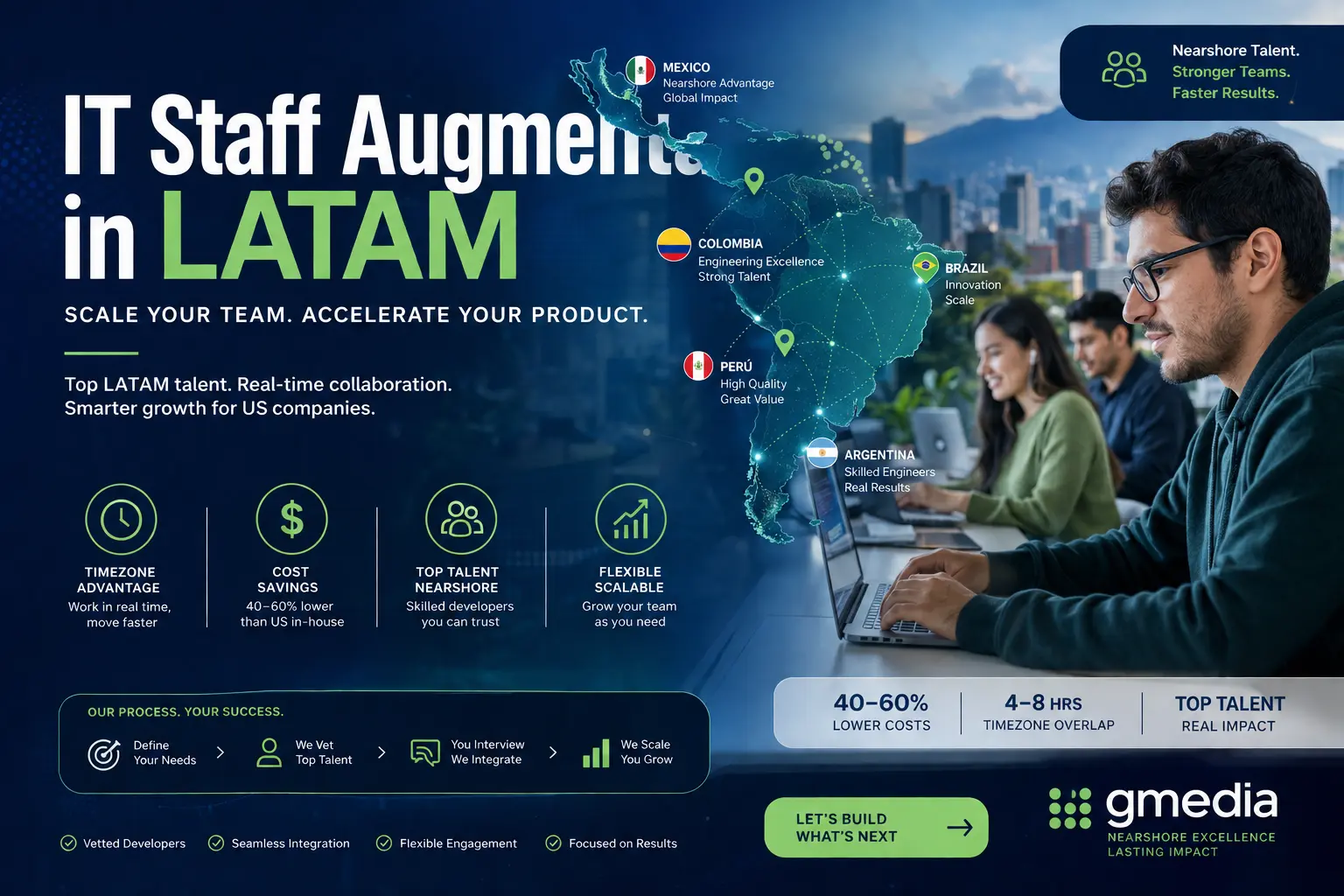
What Is IT Staff Augmentation?
IT staff augmentation is a staffing model where a company temporarily adds external developers, QA engineers, or other technical specialists to its existing team, while retaining full control over the work, tools, and processes. Unlike traditional outsourcing, where an external vendor owns an entire project, staff augmentation embeds individual professionals directly into your team, reporting to your managers and using your workflows.
When that model is applied to LATAM, it means partnering with a provider that recruits, vets, and manages developers based in countries like Mexico, Colombia, Argentina, or Peru, then places them on your team under contracts that flex up or down as your roadmap changes. It’s the fastest way to add senior engineering capacity without opening a new legal entity abroad.
Why US Companies Choose LATAM for Staff Augmentation
Three factors consistently drive US companies toward LATAM over other outsourcing regions: timezone overlap, cost efficiency, and a maturing tech talent pool. Developers in Mexico City, Bogotá, Lima, and Buenos Aires work within one to three hours of US business hours, which means daily stand-ups, sprint planning, and live debugging sessions happen in real time — something that’s much harder to coordinate with offshore teams in Eastern Europe or South Asia.
| Factor | LATAM Nearshore | Offshore (Asia/EE) |
| Timezone overlap with US | 4-8 hrs/day | 0-2 hrs/day |
| Average hourly cost vs. US in-house | 40-60% lower | 50-70% lower |
| English proficiency (tech roles) | High | Variable |
| Cultural/business-hours alignment | Strong | Limited |
Cost is still a major driver — staff augmentation in LATAM typically runs 40-60% lower than hiring the same seniority level in-house in the US — but the real value shows up in delivery speed. Real-time collaboration means fewer handoff delays, faster code reviews, and shorter feedback loops between product and engineering.
How to Hire Dedicated Developers in LATAM Successfully
A successful staff augmentation engagement follows a repeatable process rather than an ad-hoc search. Here’s the sequence that consistently works for US teams bringing on LATAM talent:
- Define the scope and seniority level you need (e.g., senior backend engineer, mobile developer, QA automation specialist).
- Partner with a provider that runs technical assessments, not just resume screening, so you only interview pre-vetted candidates.
- Run your own final interview to confirm technical fit and communication style before onboarding.
- Integrate the developer into your existing tools — Slack, Jira, GitHub, CI/CD — from day one, not after a ramp-up period.
- Set clear KPIs and a 30/60/90-day check-in cadence to measure output against your roadmap.
Flexible contract terms matter here too. Look for a partner that lets you scale the team up during a product push and down during quieter periods, without the severance costs or notice periods tied to direct local hires.
Where in LATAM to Find the Best Tech Talent
LATAM’s tech talent pool has grown substantially over the past decade, with Mexico, Colombia, Argentina, Brazil, and Peru now home to well-established software hubs. Mexico City and Guadalajara have deep benches of mobile and full-stack developers; Bogotá and Medellín have a strong fintech and backend engineering community; Buenos Aires remains one of the region’s most mature markets for senior engineering talent; and Lima has a fast-growing QA and web development scene.
For US companies, the practical upside is a wider hiring radius: instead of competing only for local talent, you can draw from a combined pool of hundreds of thousands of engineers across the region, all within a workable timezone band from Pacific to Eastern time.
What is staff augmentation in LATAM?
It’s a staffing model where a US company adds LATAM-based developers or specialists to its existing team on a contract basis, while keeping full control over management, tools, and workflow. The provider handles recruiting, vetting, payroll, and compliance in the developer’s home country.
How does staff augmentation differ from traditional outsourcing?
Traditional outsourcing hands an entire project to an external vendor that manages its own team and process. Staff augmentation instead embeds individual professionals into your team, reporting directly to your managers and following your existing workflows and tools.
Why is LATAM staff augmentation cost-effective for US companies?
Salaries and operating costs in Mexico, Colombia, Peru, and Argentina are significantly lower than in the US, so companies typically save 40-60% compared to hiring the same seniority level in-house, while still getting real-time collaboration thanks to overlapping business hours.
How much does IT staff augmentation cost in LATAM?
Rates vary by role and seniority, but a senior LATAM software engineer typically costs a fraction of an equivalent US-based hire once salary, benefits, and overhead are factored in. Getting an exact quote requires scoping the specific role and skill set with a provider.
Is staff augmentation in LATAM right for startups?
Yes — it’s often the fastest way for a startup to add senior engineering capacity without the fixed cost and hiring timeline of a full-time employee. It also lets founders scale the team up or down quickly as funding and roadmap priorities shift.
Conclusion
Staff augmentation in LATAM gives US companies a faster, more cost-effective way to add senior engineering talent without sacrificing real-time collaboration. With strong timezone overlap, a maturing talent pool across Mexico, Colombia, Argentina, Peru, and Brazil, and significant cost savings over local hiring, it’s easy to see why this model has become a default choice for scaling engineering teams in North America.
If you’re evaluating staff augmentation for your next sprint or product launch, gmedia can help you scope the role, source pre-vetted LATAM developers, and get them integrated into your team in weeks, not months. Contact us to talk through your roadmap.