What Are Mobile Apps for Business?
A business mobile app is a native or cross-platform application built to support a company’s operations, sales, or customer relationships — as opposed to a consumer app built purely for entertainment. Business mobile apps generally fall into three categories: customer-facing apps (ordering, booking, loyalty programs), internal operations apps (field service, inventory, logistics), and hybrid apps that serve both employees and customers.
Unlike a mobile-responsive website, a dedicated app can use push notifications, offline functionality, device hardware (camera, GPS, biometrics), and faster, more personalized interactions — all of which drive the engagement and efficiency gains covered below.
Key Benefits of Mobile Apps for Business
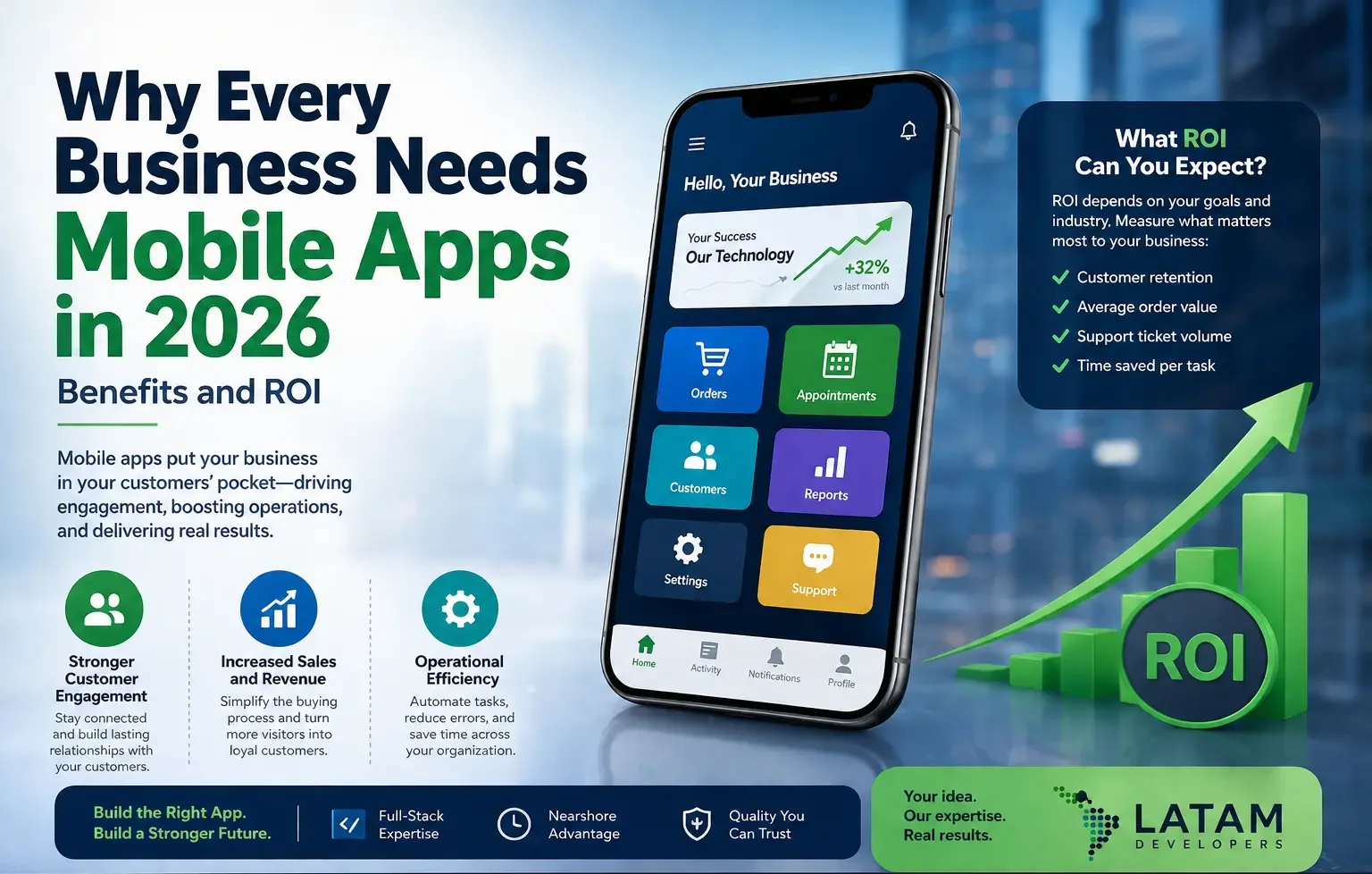
Stronger Customer Engagement
Apps give you a direct channel to your customers that isn’t filtered by email spam folders or social media algorithms. Push notifications, in-app messaging, and loyalty features keep your brand top of mind and make it easier to turn one-time buyers into repeat customers.
Increased Sales and Revenue
A smoother checkout flow, saved payment details, and personalized product recommendations all reduce friction in the buying process. Many companies also use their app to test new offers or bundles faster than they could through a website redesign.
Operational Efficiency
On the internal side, mobile apps for business can replace paper-based processes — field teams can log jobs, update inventory, or capture signatures from a phone instead of a spreadsheet. That reduces data-entry errors and speeds up the handoff between departments.
What ROI Can You Expect From a Business Mobile App?
ROI from a mobile app depends heavily on your industry, your existing digital channels, and how the app is used — so treat any generic percentage you see online with some skepticism. Instead, ROI is best measured against a handful of concrete metrics you set before development starts: customer retention rate, average order value, support ticket volume, or time saved per internal task.
A practical way to approach this is to start with a minimum viable version of the app focused on your highest-impact use case (for example, faster checkout or appointment booking), measure results for a full quarter, and then expand functionality based on what actually moves the metrics that matter to your business.
How to Choose the Right Team to Build Your Business Mobile App
Because mobile development spans design, native/cross-platform engineering, QA, and backend integrations (payments, CRM, inventory systems), most companies get better results — and a faster time to market — by working with a dedicated development team rather than hiring each role individually.
Look for a partner who can show experience across the full stack your app will need, works in your time zone or close to it, and has a clear QA process. This is where nearshore teams in Latin America have become a popular option for U.S. companies: similar working hours, strong technical talent, and lower overhead than building an in-house team from scratch.
Do small businesses really need mobile apps for business, or is that just for large companies?
Small and mid-sized businesses can benefit as much as large enterprises, especially if customers already interact with them repeatedly (bookings, orders, loyalty programs). The key is starting with a focused app rather than trying to replicate every feature a big-brand app has.
How long does it take to build a business mobile app?
A focused first version typically takes 3–6 months depending on scope, platforms (iOS, Android, or both), and how many third-party integrations are required. Working with an experienced dedicated team can shorten this timeline.
What’s the difference between a mobile app and a mobile-friendly website?
A mobile-friendly website is a responsive version of your site viewed through a browser. A mobile app is installed on the device, can work offline, sends push notifications, and generally offers a faster, more personalized experience.
How much does it cost to build mobile apps for business?
Costs vary widely based on features, platforms, and integrations, ranging from a lean MVP to a full-featured product with custom backend systems. Most development partners will scope this with you after understanding your specific use case.
Should we build for iOS, Android, or both?
This depends on where your customers or employees are — for consumer apps, check your existing web analytics for device breakdown; for internal tools, it depends on the devices your team already uses.
Mobile apps for business have moved from a competitive advantage to an expectation in many industries. Whether the goal is deeper customer engagement, more sales, or leaner internal operations, the businesses that get the most value are the ones that start with a clear use case, define success metrics up front, and work with a team experienced across the full mobile development stack.
If you’re evaluating whether a mobile app makes sense for your business, gmedia can help you scope, build, and support it with a dedicated development team. Get in touch to talk through your use case.